Event Reference
This is a reference to all events broadcasted in the internal event bus, including their available attributes.
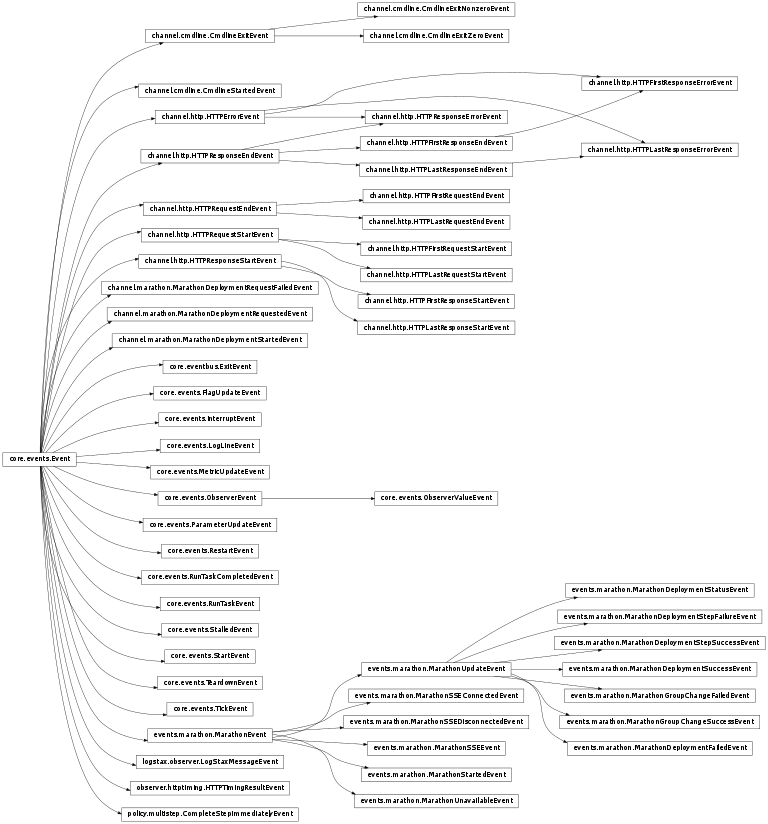
Event Details
-
class
performance.driver.classes.channel.cmdline.CmdlineExitEvent(exitcode, **kwargs)[source]¶ This event is published when the process launched through the cmdline channel has completed. The exit code is tracked.
-
exitcode= None¶ The exit code of the application launched by the command-line channel
-
-
class
performance.driver.classes.channel.cmdline.CmdlineExitNonzeroEvent(exitcode, **kwargs)[source]¶ This event is published when the process exited and the exit code is non-zero
-
class
performance.driver.classes.channel.cmdline.CmdlineExitZeroEvent(exitcode, **kwargs)[source]¶ This event is published when the process exited and the exit code is zero
-
class
performance.driver.classes.channel.cmdline.CmdlineStartedEvent(pid, *args, **kwargs)[source]¶ This event is published when the process has started. It contains the process ID so the observers can attach to the process and extract useful data.
-
class
performance.driver.classes.channel.http.HTTPErrorEvent(exception, *args, **kwargs)[source]¶ Published when an exception is raised during an HTTP operation (ex. connection error)
-
exception= None¶ The exception that was raised
-
-
class
performance.driver.classes.channel.http.HTTPFirstRequestEndEvent(verb, url, body, headers, *args, **kwargs)[source]¶ Published when the first request out of many is completed. This is valid when a
repeatparameter has a value > 1.
-
class
performance.driver.classes.channel.http.HTTPFirstRequestStartEvent(verb, url, body, headers, *args, **kwargs)[source]¶ Published when the first request out of many is started. This is valid when a
repeatparameter has a value > 1.
-
class
performance.driver.classes.channel.http.HTTPFirstResponseEndEvent(url, body, headers, *args, **kwargs)[source]¶ Published when the first response out of many has completed. This is valid when a
repeatparameter has a value > 1.
-
class
performance.driver.classes.channel.http.HTTPFirstResponseErrorEvent(url, body, headers, exception, *args, **kwargs)[source]¶ Published when the first response out of many has an error. This is valid when a
repeatparameter has a value > 1.
-
class
performance.driver.classes.channel.http.HTTPFirstResponseStartEvent(url, *args, **kwargs)[source]¶ Published when the first response out of many is starting. This is valid when a
repeatparameter has a value > 1.
-
class
performance.driver.classes.channel.http.HTTPLastRequestEndEvent(verb, url, body, headers, *args, **kwargs)[source]¶ Published when the last request out of many is completed. This is valid when a
repeatparameter has a value > 1.
-
class
performance.driver.classes.channel.http.HTTPLastRequestStartEvent(verb, url, body, headers, *args, **kwargs)[source]¶ Published when the last request out of many is started. This is valid when a
repeatparameter has a value > 1.
-
class
performance.driver.classes.channel.http.HTTPLastResponseEndEvent(url, body, headers, *args, **kwargs)[source]¶ Published when the last response out of many has completed. This is valid when a
repeatparameter has a value > 1.
-
class
performance.driver.classes.channel.http.HTTPLastResponseErrorEvent(url, body, headers, exception, *args, **kwargs)[source]¶ Published when the last response out of many has an error. This is valid when a
repeatparameter has a value > 1.
-
class
performance.driver.classes.channel.http.HTTPLastResponseStartEvent(url, *args, **kwargs)[source]¶ Published when the last response out of many is starting. This is valid when a
repeatparameter has a value > 1.
-
class
performance.driver.classes.channel.http.HTTPRequestEndEvent(verb, url, body, headers, *args, **kwargs)[source]¶ Published when the HTTP request has completed and the response is starting
-
body= None¶ The request body
-
headers= None¶ The request headers
-
url= None¶ The URL requested
-
verb= None¶ The HTTP verb that was used (in lower-case). Ex:
get
-
-
class
performance.driver.classes.channel.http.HTTPRequestStartEvent(verb, url, body, headers, *args, **kwargs)[source]¶ Published before every HTTP request
-
body= None¶ The request body
-
headers= None¶ The request headers
-
url= None¶ The URL requested
-
verb= None¶ The HTTP verb that was used (in lower-case). Ex:
get
-
-
class
performance.driver.classes.channel.http.HTTPResponseEndEvent(url, body, headers, *args, **kwargs)[source]¶ Published when the HTTP response has completed
-
body= None¶ The response body (as string)
-
headers= None¶ The response headers
-
url= None¶ The URL requested
-
-
class
performance.driver.classes.channel.http.HTTPResponseErrorEvent(url, body, headers, exception, *args, **kwargs)[source]¶ Published when an exception was raised while processing an HTTP response. This is valid when a
repeatparameter has a value = 1.
-
class
performance.driver.classes.channel.http.HTTPResponseStartEvent(url, *args, **kwargs)[source]¶ Published when the HTTP response is starting.
-
url= None¶ The URL requested
-
-
class
performance.driver.classes.channel.marathon.MarathonDeploymentRequestFailedEvent(instance, status_code, respose, *args, **kwargs)[source]
-
class
performance.driver.classes.channel.marathon.MarathonDeploymentRequestedEvent(instance, *args, **kwargs)[source]
-
class
performance.driver.classes.channel.marathon.MarathonDeploymentStartedEvent(instance, *args, **kwargs)[source]
-
class
performance.driver.classes.observer.events.marathon.MarathonDeploymentFailedEvent(deployment, affectedInstances, *args, **kwargs)[source]
-
class
performance.driver.classes.observer.events.marathon.MarathonDeploymentStatusEvent(deployment, affectedInstances, *args, **kwargs)[source]
-
class
performance.driver.classes.observer.events.marathon.MarathonDeploymentStepFailureEvent(deployment, affectedInstances, *args, **kwargs)[source]
-
class
performance.driver.classes.observer.events.marathon.MarathonDeploymentStepSuccessEvent(deployment, affectedInstances, *args, **kwargs)[source]
-
class
performance.driver.classes.observer.events.marathon.MarathonDeploymentSuccessEvent(deployment, affectedInstances, *args, **kwargs)[source]
-
class
performance.driver.classes.observer.events.marathon.MarathonEvent(traceid=None, ts=None)[source]¶ Base class for all marathon-related events
-
class
performance.driver.classes.observer.events.marathon.MarathonGroupChangeFailedEvent(deployment, groupid, reason, *args, **kwargs)[source]
-
class
performance.driver.classes.observer.events.marathon.MarathonGroupChangeSuccessEvent(deployment, groupid, *args, **kwargs)[source]
-
class
performance.driver.classes.observer.events.marathon.MarathonSSEConnectedEvent(traceid=None, ts=None)[source]¶ Raw SSE endpoint was connected
-
class
performance.driver.classes.observer.events.marathon.MarathonSSEDisconnectedEvent(traceid=None, ts=None)[source]¶ Raw SSE endpoint was disconnected
-
class
performance.driver.classes.observer.events.marathon.MarathonSSEEvent(eventName, eventData, *args, **kwargs)[source]¶ Raw SSE event
-
class
performance.driver.classes.observer.events.marathon.MarathonStartedEvent(traceid=None, ts=None)[source]¶ Marathon is up and accepting HTTP requests
Marathon is up and accepting HTTP requests
-
class
performance.driver.classes.observer.events.marathon.MarathonUpdateEvent(deployment, instances, *args, **kwargs)[source]¶ Base class for update events
-
class
performance.driver.classes.observer.httptiming.HTTPTimingResultEvent(url, verb, statusCode, requestTime, responseTime, totalTime, contentLength, *args, **kwargs)[source]¶ The results of a timing event, initiated by a
HTTPTimingObserver-
contentLength= None¶ The length of the response body
-
requestTime= None¶ The time the HTTP request took to complete
-
responseTime= None¶ The time the HTTP response took to complete
-
statusCode= None¶ The HTTP response code
-
totalTime= None¶ The overall time from the beginning of the request, till the end of the response
-
url= None¶ The URL requested
-
verb= None¶ The HTTP verb used to request this resource
-
-
class
performance.driver.classes.observer.logstax.observer.LogStaxMessageEvent(message, **kwargs)[source]
-
class
performance.driver.classes.policy.multistep.CompleteStepImmediatelyEvent(traceid=None, ts=None)[source]
-
class
performance.driver.core.eventbus.ExitEvent(traceid=None, ts=None)[source]¶ A local event that instructs the main event loop to exit
-
class
performance.driver.core.events.Event(traceid=None, ts=None)[source]¶ Base event
The traceid parameter is a unique string or object that is carried along related events and is used to group them together to the same operation.
-
class
performance.driver.core.events.FlagUpdateEvent(name, value, *args, **kwargs)[source]¶ A flag has changed for this run
-
class
performance.driver.core.events.InterruptEvent(traceid=None, ts=None)[source]¶ An interrupt event is dispatched when a critical exception has occurred or when the user has instructed to interupt the tests via a keystroke
-
class
performance.driver.core.events.LogLineEvent(line, source, kind=None, *args, **kwargs)[source]¶ A log line from an observer
-
class
performance.driver.core.events.MetricUpdateEvent(name, value, *args, **kwargs)[source]¶ A metric has changed
-
class
performance.driver.core.events.ObserverEvent(metric, *args, **kwargs)[source]¶ A metric change is observed
-
class
performance.driver.core.events.ObserverValueEvent(metric, value, *args, **kwargs)[source]¶ A metric has changed to a new value
-
class
performance.driver.core.events.ParameterUpdateEvent(newParameters, oldParameters, changes, *args, **kwargs)[source]¶ A parameter change request
-
class
performance.driver.core.events.RestartEvent(traceid=None, ts=None)[source]¶ A restart event is dispatched in place of StartEvent when more than one test loops has to be executed.
-
class
performance.driver.core.events.RunTaskCompletedEvent(previousEvent, exception=None)[source]¶ This event is displatched when a task is completed. This is useful if you want to keep track of a lengthy event
-
class
performance.driver.core.events.RunTaskEvent(task)[source]¶ This event is dispatched when a policy requires the session to execute a task
-
class
performance.driver.core.events.StalledEvent(traceid=None, ts=None)[source]¶ An stalled event is dispatched from the session manager when an FSM has stuck to a non-terminal state for longer than expected time.
-
class
performance.driver.core.events.StartEvent(traceid=None, ts=None)[source]¶ A start event is dispatched when the test configuration is loaded and the environment is ready, in order to start the policies.